Impact of the Lorna Myers PNES Scholarship: American Epilepsy Society 2026 Poster Presentation Preview
Published on November 19th, 2026 in News
Impact of the Lorna Myers PNES Scholarships: Poster Presentation at American Epilepsy Society (AES) 2026 Annual Meeting
Epilepsy Alliance America is proud to have managed the Lorna Myers PNES Scholarship Fund since 2021. Lisa Gallipoli and Cassie Corral, staff members of Epilepsy Alliance America, are pleased to be co-authors of the poster which will be shared at the American Epilepsy Society (AES) 2026 Annual meeting in Denver, Colorado in December, 2026, along side Lorna Myers, PhD., Patricia Gibson, MSSW, DHL, ACSW, Bruce Hermann, PhD., and Yael Monselise, LSCW, SIFI.
Impact of the Lorna Myers PNES Scholarships: Poster Presentation at American Epilepsy Society (AES) 2026 Annual Meeting
Epilepsy Alliance America is proud to have managed the Lorna Myers PNES Scholarship Fund since 2021. Lisa Gallipoli and Cassie Corral are pleased to be co-authors of the poster which will be shared at the American Epilepsy Society (AES) 2026 Annual meeting in Denver, Colorado in December, 2026, along side Lorna Myers, PhD., Patricia Gibson, MSSW, DHL, ACSW, Bruce Hermann, PhD., and Yael Monselise, LSCW, SIFI.
Psychogenic nonepileptic seizures, or PNES, can present significant challenges for students pursuing higher education. Beyond the seizures themselves, students may experience difficulties with concentration, frequent absences, and the need for academic accommodations.
Since 2021, the Lorna Myers PNES Scholarship, managed by Epilepsy Alliance America, has provided financial support to students living with PNES. The scholarship is funded through the donation of the royalties from the book Psychogenic Nonepileptic Seizures: A Guide, authored by Dr. Lorna Myers, along with contributions from other donors.
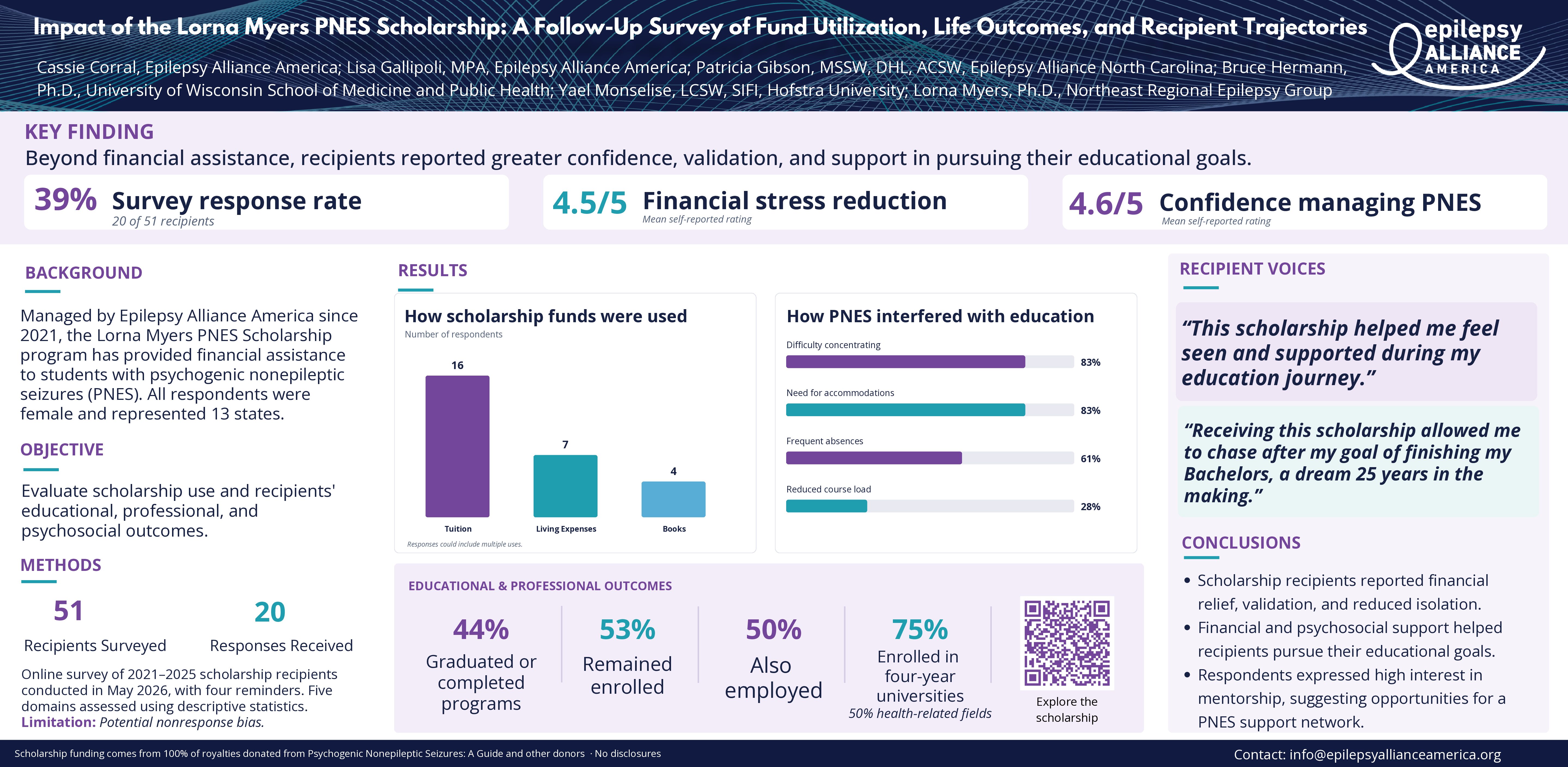
Impact of the Lorna Myers PNES Scholarship: A Follow-Up Survey of Fund Utilization, Life Outcomes and Recipient Trajectories
Our study sought to understand how recipients used their scholarship funds and how receiving the award influenced their educational experiences, confidence, and overall well-being.
We surveyed 51 scholarship recipients from 2021 through 2025 and received 20 responses, representing a 39 percent response rate.
The findings highlight both the financial and psychosocial benefits of the scholarship.
Recipients reported an average financial stress reduction rating of 4.5 out of 5, along with an average rating of 4.6 out of 5 for increased confidence in managing PNES.
Scholarship funds were most commonly used for tuition, followed by housing and living expenses, and books.
The survey also highlighted the educational challenges recipients faced. Eighty-three percent reported difficulty concentrating, and the same percentage reported needing academic accommodations. Sixty-one percent experienced frequent absences, while 28 percent reported reducing their course load.
Despite these challenges, recipients continued pursuing their educational and professional goals. At follow-up, 44 percent had graduated or completed their programs, 53 percent remained enrolled, and half were also employed.
But perhaps some of the most meaningful findings came from recipients' personal reflections.
One recipient shared, This scholarship helped me feel seen and supported during my education journey.
Another described how the scholarship helped them pursue a bachelor's degree that had been a dream for 25 years.
These experiences suggest that the scholarship offers something beyond financial assistance: a sense of validation, encouragement, and recognition.
Respondents also expressed strong interest in mentorship, suggesting opportunities to build a broader support network for students living with PNES.
Although our findings are limited by the survey response rate and potential nonresponse bias, they suggest that targeted scholarship support can play a meaningful role in helping students with PNES pursue their academic and professional goals.
Learn more about the Lorna Myers PNES Scholarship here.